


Where Deep Groove Ball Bearings Actually Fit Best
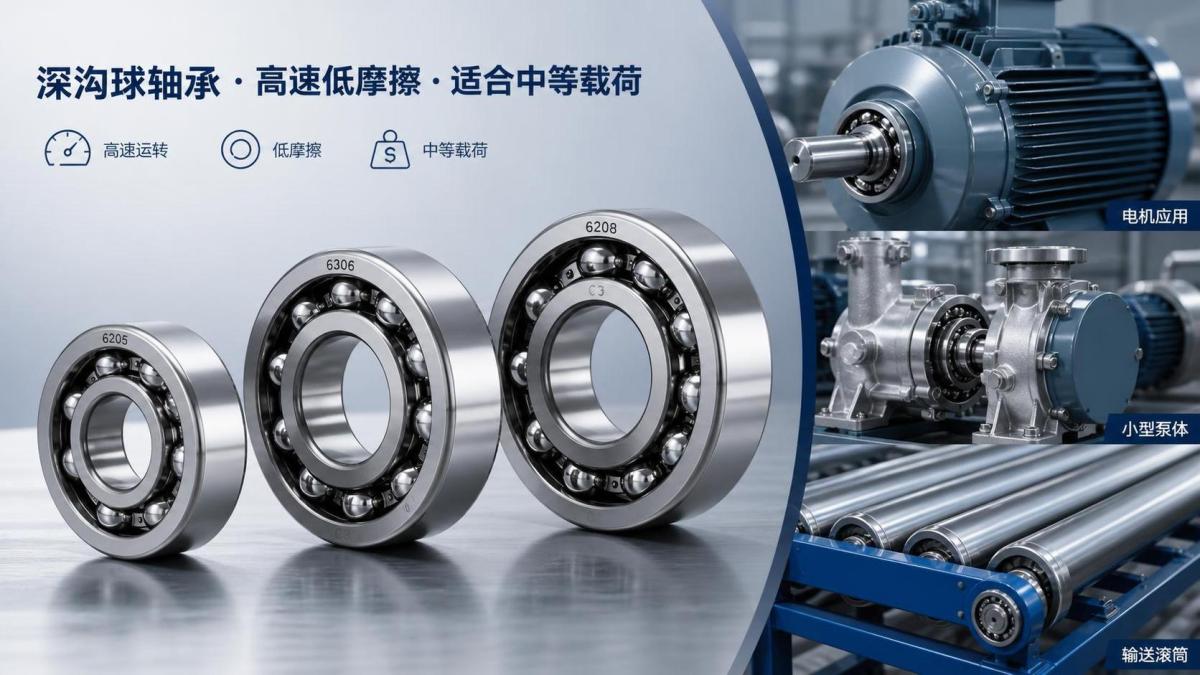
Deep groove ball bearing applications are everywhere, but that does not mean one bearing suits every machine equally well. In practice, these bearings are chosen because they are simple, cost-effective, easy to source globally, and capable of handling high rotational speed with relatively low friction. That combination is hard to beat in equipment where the load is moderate, alignment is reasonably controlled, and maintenance teams want predictable service life rather than a complicated bearing arrangement.
Electric motors are probably the most familiar example. Small and medium motors often rely on deep groove ball bearings because they run quietly, support radial loads well, and can also take a certain amount of axial load. In export markets, this matters a lot. Buyers are not only comparing dimensions and price; they are looking at noise behavior, grease retention, seal choice, and whether replacement stock will remain consistent across batches.
Jinan Lanyu works in this kind of supply environment every day. As a bearing manufacturing enterprise focused on import and export trade, it deals with demand that is rarely one-dimensional. Deep groove ball bearings may be the starting point, but customers often compare them with self-aligning ball bearings or cylindrical roller bearings once vibration, shaft deflection, or load changes enter the discussion.
Typical Industries and Why They Use Them
Household appliances are a classic application area. Fans, washing machines, vacuum motors, and small pumps need smooth rotation, acceptable noise levels, and reasonable durability at controlled cost. Here, deep groove ball bearings make sense because the operating environment is usually not extreme, and compact design matters. If the appliance faces moisture or dust, sealing and grease selection become more important than simply choosing a higher precision grade.
Automotive systems use them too, but with more caution. Alternators, compressors, starter motors, and some gearbox-related auxiliary assemblies may use deep groove ball bearings where speed is high and packaging is tight. The catch is that automotive duty cycles can be harsher than they look on paper. Temperature swings, contamination, belt tension, and shock load all affect bearing life. Engineers who ignore these conditions often blame the bearing type when the real issue was preload, fit tolerance, or lubrication breakdown.
Industrial machinery is broader and less forgiving. Conveyor rollers, small gearboxes, agricultural attachments, light-duty machine tools, pumps, and packaging equipment often run well with deep groove ball bearings. But once the machine sees serious impact load, shaft misalignment, or heavy axial force, the selection process changes. That is where a buyer may move toward cylindrical roller bearings for higher radial load capacity, or self-aligning designs when shaft deflection is difficult to avoid.
The Real Selection Question Is Not “Can It Work?”
Many deep groove ball bearing applications look acceptable in catalog terms. The more useful question is whether the bearing will still perform well after months of dust ingress, uneven mounting, temperature rise, and stop-start operation. That is usually where experienced buyers become more careful.
A few checks are worth making early:
- Is the load mostly radial, or is there meaningful axial force in both directions?
- Will the shaft and housing maintain alignment under running conditions?
- Is speed the priority, or is contamination the bigger threat?
- Does the application need open, shielded, or sealed bearing design?
- Is standard clearance enough, or should internal clearance be reviewed against temperature and fit?
These are not small details. A bearing chosen only by boundary dimensions may fit the shaft and still fail in service for reasons that were visible from the start.
When Deep Groove Ball Bearings Are the Wrong Answer
This is where selection discipline matters. Deep groove ball bearings are versatile, but they are not the best option for every load case. In mining, vibrating screens, heavy reducers, or severely misaligned housings, a more robust solution is often needed. For example, a spherical roller bearing can absorb misalignment and carry heavier combined loads that would quickly challenge a standard deep groove design.
That is why some buyers sourcing general bearing ranges want one supplier that can cover more than one operating scenario. A company handling both deep groove products and heavier-duty types can usually give more practical advice on substitution limits. In some projects, a unit such as TIMKEN 23220EJW33 Spherical Roller Bearing makes more sense than forcing a ball bearing into a position with shaft deflection or high shock load. Its listed dimensions, including a 100 mm bore, 180 mm outer diameter, and 60.3 mm width, already place it in a different duty class than the compact deep groove bearings used in motors or appliances.
Common Mistakes Buyers and Maintenance Teams Run Into
One common mistake is assuming higher precision automatically means longer life. Precision grades such as P6, P5, or P4 can be important, but only if the application benefits from tighter running accuracy. For a dusty conveyor or an agricultural attachment, contamination control and fit accuracy may matter more than moving to a premium precision class.
Another mistake is overlooking internal clearance. Clearance options like C2, C0, C3, C4, and C5 exist for a reason. A tight fit on the shaft, higher operating temperature, or rapid speed can reduce effective clearance in operation. On the other hand, too much clearance can create vibration, noise, or unstable running. This point often needs to be confirmed against actual housing tolerance, shaft material, and thermal behavior, not guessed from habit.
Packaging and logistics are also more relevant than many engineers expect. In export business, consistent transport protection, labeling, and palletized shipment reduce handling damage and warehouse confusion. That may sound basic, but in bearing trade, repeatability is often what separates a smooth supply chain from one full of avoidable claims.
What Buyers Usually Want Beyond the Catalog
A catalog gives dimensions and standard ratings; it does not tell you how a supplier handles mixed orders, replacement continuity, or model cross-referencing across brands. Jinan Lanyu’s import and export portfolio covers deep groove ball bearings, self-aligning ball bearings, and cylindrical roller bearings, which is useful for buyers who are managing different machine families at once. That kind of range helps when a project starts with one bearing type and later shifts because the field conditions prove rougher than expected.
Sometimes the practical question is not performance alone, but service flexibility. OEM support, material consistency such as chrome steel GCr15, available precision grades, and common clearance classes all affect whether a bearing program can scale from trial order to regular purchasing. Even with a product like the TIMKEN 23220EJW33 listed with sheet steel cage construction and multiple precision and clearance options, the final suitability still depends on the actual machine layout and operating load.
A Useful Way to Think About Application Fit
If the application is clean, speed matters, radial load is dominant, and alignment is controlled, deep groove ball bearings are often the efficient choice. If the machine starts seeing heavier impact, more shaft movement, or difficult installation conditions, that is usually the moment to pause and review alternatives instead of staying with the familiar option.
That is really the center of deep groove ball bearing applications: not that they are universal, but that they are excellent within the right operating window. Good selection comes from matching that window to the machine, the duty cycle, and the supply realities behind it. If those three line up, the bearing tends to disappear into the background and simply do its job, which is exactly what most users want.
Navigation
Send Us A Message
consult

Jinan Lanyu Import & Export Co., Ltd. is a bearing manufacturing enterprise specializing in the import and export trade of bearings. Covering a total area of 50,000 square meters, the company boasts an annual production capacity exceeding 20 million sets and is dedicated to the manufacture of high-quality bearings.

First class quality service and professional after-sales team.
Get in Touch
*We respect your confidentiality and all information are protected.
