


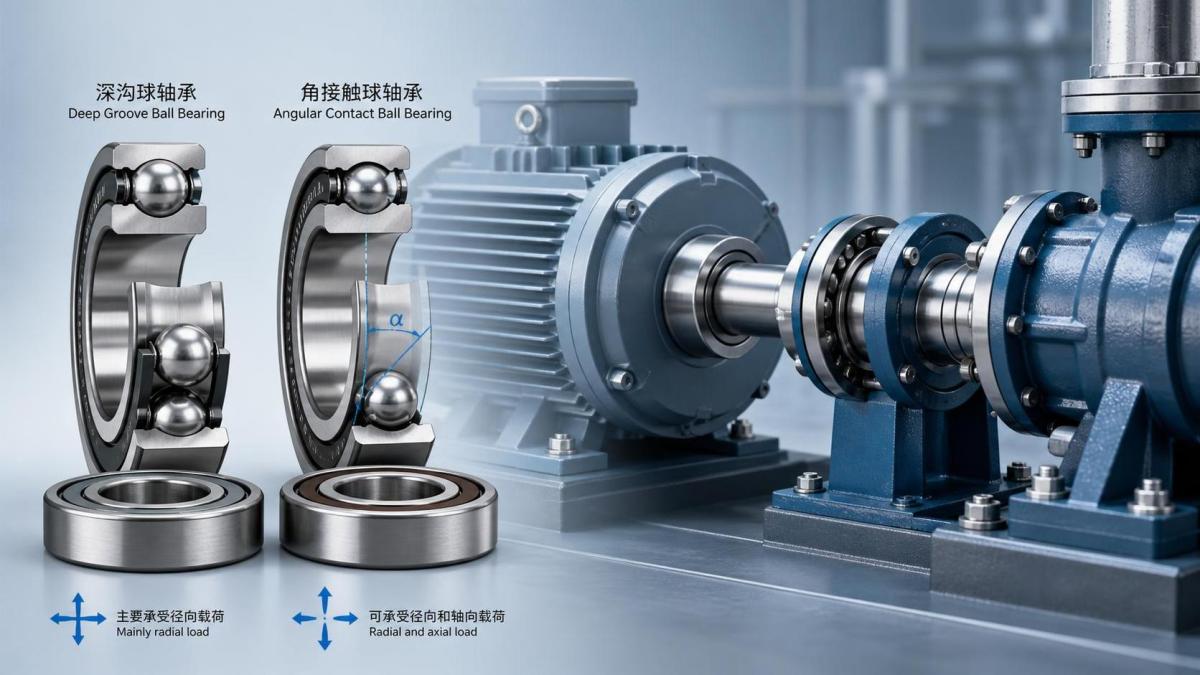
Deep groove ball bearings and angular contact bearings may look similar at first glance, yet their internal geometry leads to very different behavior once speed, load direction, fit tolerance, and operating temperature begin to matter. The basic distinction is in the raceway design. A deep groove ball bearing has raceways that allow it to carry radial load efficiently while also accepting moderate axial load in either direction. An angular contact bearing is built with a contact angle between the balls and raceways, so it is better suited to combined loads and can sustain higher axial load, especially when that load acts in a defined direction.
That design difference affects selection far beyond a catalog table. In a deep groove ball bearing, the ball-to-raceway contact is optimized for smooth running, low friction, and broad general-purpose use. It is common in electric motors, pumps, fans, household equipment, conveyors, and light industrial machinery because it tolerates relatively high speed with simple mounting requirements. Angular contact bearings are more sensitive to arrangement and preload. They are often chosen for machine tool spindles, pumps with thrust load, gearboxes, and assemblies where shaft positioning accuracy matters along with rotation speed.
Load Direction Changes the Decision
When comparing deep groove ball bearing vs angular contact bearing, the first technical question is rarely size. It is load direction. A deep groove bearing can handle radial load well and axial load from both sides, but its axial capacity is limited by the groove geometry and internal clearance. If the application sees continuous thrust, shock thrust, or combined load at high speed, an angular contact bearing usually gives a more stable result because the contact angle directs force through the rolling elements in a more controlled path.
Single-row angular contact bearings typically carry axial load in one direction, so they are frequently mounted in pairs. The arrangement matters: back-to-back mounting tends to improve moment rigidity, while face-to-face mounting can tolerate some misalignment more easily. Tandem arrangements may be used where axial load in one direction is dominant. Deep groove ball bearings do not usually require that level of pairing logic, which is one reason they remain common in simpler shaft systems.
Speed, Friction, and Heat
Both bearing types can run at high speed if lubrication, cage design, and fits are appropriate, but operating behavior is not identical. Deep groove ball bearings generally offer very low friction and straightforward lubrication management. In normal-duty applications with grease lubrication, they often run quietly and predictably. Angular contact bearings can also achieve high speed, especially in precision versions, but preload and lubricant selection become much more sensitive. Excess preload raises heat quickly, and too little preload can allow vibration, skidding, or poor running accuracy.
This is where installation practice starts to influence bearing life more than the nominal type itself. A well-selected angular contact bearing can fail early if mounted without controlling preload, shoulder squareness, or spacer tolerance. A deep groove bearing can also fail if interference fits are too heavy, if the housing seat is out of round, or if thermal growth closes internal clearance during operation. In field failures, these assembly details are often mistaken for material defects.
Rigidity and Shaft Control
Angular contact bearings are usually chosen when axial positioning and rigidity are important. The contact angle allows the bearing to resist combined forces with less elastic displacement under load than a general-purpose deep groove design in the same operating condition. That matters in spindles, precision drive systems, and equipment where deflection affects cut quality, gear mesh, or seal performance.
Deep groove ball bearings are more forgiving in standard rotating equipment, especially where the shaft sees mainly radial load and only modest thrust. They are also easier to source across many clearance classes, seal configurations, and shielding options. For contaminated environments, sealed deep groove bearings can reduce maintenance complexity. Angular contact bearings usually require cleaner assembly conditions and more attention to lubrication cleanliness because running accuracy depends heavily on raceway condition.
Material and Manufacturing Considerations
For both types, bearing steel cleanliness, heat treatment stability, raceway grinding accuracy, and cage quality influence performance. The practical difference is that angular contact bearings tend to expose manufacturing variation more quickly in demanding applications. Runout, contact angle consistency, and dimensional control affect preload behavior and speed capability. Deep groove ball bearings are not insensitive to these factors, but they are often used in systems with wider tolerance bands.
Surface finish also matters at startup and under thin-film lubrication. Poor raceway finish can increase noise, friction, and local heating. In export transactions, dimensional standards, internal clearance class, cage material, and seal type should be confirmed in writing because a correct boundary dimension alone does not ensure the same operating behavior. Confusion often appears when one side orders a bearing by number only, while the actual application requires a specific clearance, vibration grade, or lubrication fill.
Installation Risks That Are Often Overlooked
Deep groove bearings are sometimes treated as if they can be pressed into place without much preparation. That is a common mistake. Pressing force must pass through the ring being fitted; otherwise, load may mark the raceways through the balls. For angular contact bearings, the same rule applies, but the consequences are more severe when paired mounting and preload are involved. Mixing unmatched bearings, reversing orientation, or reusing worn spacers can produce heat and noise that appear only after several hours of running.
Another frequent error is ignoring fit relationships between shaft, housing, and thermal expansion. A shaft carrying rotating load usually requires interference on the inner ring, while housing fit may remain looser depending on load direction and service conditions. If both rings are locked too tightly without allowance for heat growth, internal clearance can collapse. If fits are too loose, creep may damage seating surfaces and generate iron oxide debris.
Application Boundaries
Deep groove ball bearings are often the practical choice for compact equipment with mixed but moderate loads, moderate misalignment sensitivity, and routine maintenance expectations. Angular contact bearings make more sense where thrust load is persistent, shaft guidance must remain accurate, or higher rigidity is needed. The boundary is not absolute, and some machines use both types in different positions of the same shaft line.
In systems dominated by heavy radial load rather than ball-bearing style combined load, another rolling element design may be considered. For example, Cylindrical roller bearings are separable bearings with linear roller contact, small friction coefficient, strong rigidity, and large radial load capacity. Types such as N, NU, NJ, NF, NUP, NN, and NNU are commonly associated with medium and large motors, generators, machine tool spindles, speed reducers, and rolling mills, especially where easy installation and disassembly are useful.
Procurement and Transport Details That Affect Performance
Selection errors often begin before installation. Bearings shipped without confirmed rust prevention, packaging condition, or relubrication instructions may arrive technically correct but operationally compromised. Moisture exposure during long transit can stain raceways. Mixed batch packaging can create traceability gaps when vibration or noise problems appear later. It is also worth confirming whether the bearing is preserved for oil lubrication, grease fill, or dry shipment, because over-greasing at startup can raise temperature and under-greasing can damage the contact surfaces quickly.
For angular contact bearings, pair configuration and universal matching status should be specified where relevant. For deep groove bearings, internal clearance and seal arrangement deserve equal attention. A quiet-running motor bearing with low vibration expectation is not the same item as an open bearing of the same boundary dimensions intended for a gearbox with oil bath lubrication.
Common Misjudgments in Deep Groove Ball Bearing vs Angular Contact Bearing Selection
- Assuming axial load in both directions automatically favors a deep groove design, even when thrust is continuous and substantial at speed.
- Choosing angular contact bearings for every high-speed application without evaluating whether the system can actually control preload, alignment, and lubrication cleanliness.
- Using dimension interchangeability as proof of functional interchangeability.
- Treating noise, heat, or early wear as a bearing type issue when the root cause may be fit error, contamination, shaft shoulder inaccuracy, or handling damage.
The better comparison is not which bearing is generally better, but which internal geometry matches the real load path and assembly condition. Once that is clear, the difference between stable service and recurring failure becomes much easier to explain at the drawing, purchasing, and maintenance stages.
Navigation
Send Us A Message
consult

Jinan Lanyu Import & Export Co., Ltd. is a bearing manufacturing enterprise specializing in the import and export trade of bearings. Covering a total area of 50,000 square meters, the company boasts an annual production capacity exceeding 20 million sets and is dedicated to the manufacture of high-quality bearings.

First class quality service and professional after-sales team.
Get in Touch
*We respect your confidentiality and all information are protected.
