


Many people only start thinking about deep groove ball bearing clearance after something feels wrong in operation. A motor runs hotter than expected, a fan becomes noisy after startup, or a machine that used to feel smooth suddenly develops vibration. In many of these situations, the bearing itself is blamed first, but the real issue may be that the internal clearance was not appropriate for the working conditions.
That is why deep groove ball bearing clearance matters so much in day-to-day selection and maintenance. Clearance affects running temperature, noise, speed capability, and the way the bearing handles load once it is mounted. If you are comparing bearing options for industrial equipment, replacement work, or stock purchasing, understanding this one parameter can prevent a lot of avoidable trouble later.
Where confusion usually starts
A common misunderstanding is to assume that more clearance is always safer, or that standard clearance is fine for nearly every application. In practice, neither idea holds up very well. The correct choice depends on what happens to the bearing after installation and during operation.
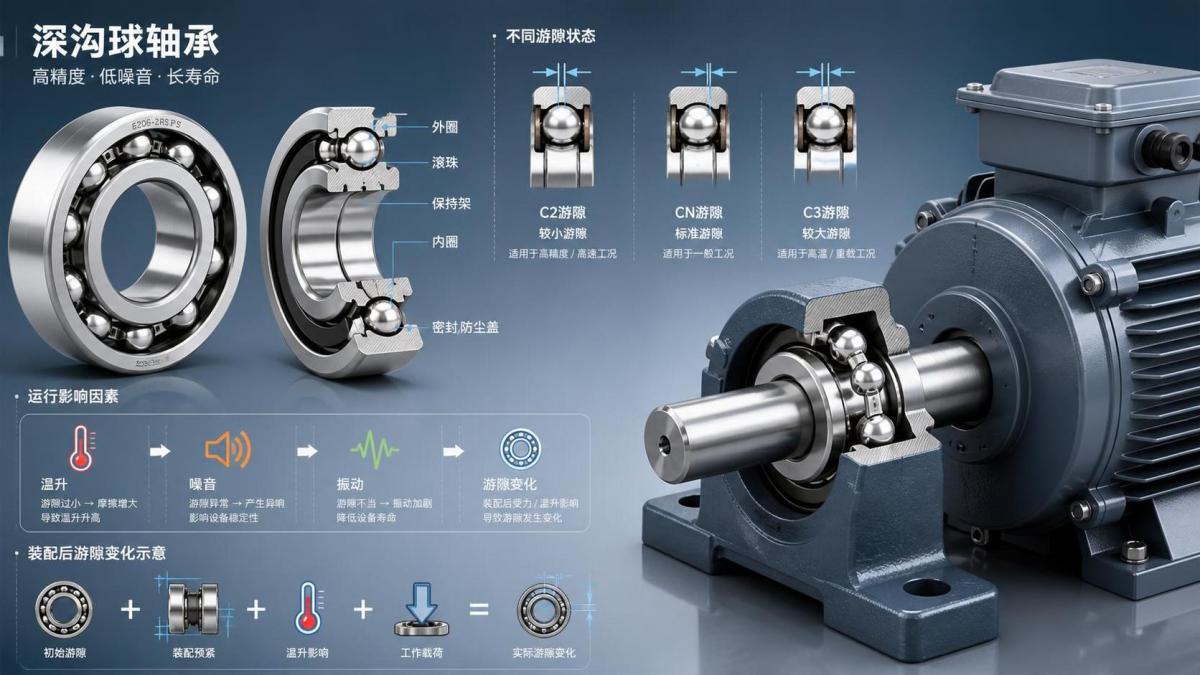
Before mounting, internal clearance means the total distance one ring can move relative to the other, either radially or axially, depending on the measurement. For deep groove ball bearings, people usually focus on radial internal clearance. What complicates selection is that the operating clearance is not the same as the initial clearance listed in a catalog.
Once the bearing is fitted on a shaft or into a housing, the fit can reduce clearance. Then, when temperature rises, the inner ring may expand differently from the outer ring, changing the clearance again. So the value you buy is only the starting point. The value the bearing runs with is the one that decides whether the application will stay stable.
What happens when clearance is too small
If clearance becomes too tight in operation, the rolling elements no longer move with enough freedom. Friction increases, temperature builds, and lubrication conditions can worsen. In a real workshop setting, this may show up as a machine that sounds normal at first but gets louder or hotter after running for a while.
Too little clearance can also shorten bearing life because contact stress rises. In higher-speed equipment, this may become even more noticeable. Even when the load is not especially heavy, the bearing may feel rougher than expected simply because the internal operating condition is too tight.
This is one reason buyers often look beyond a default C0 choice when the shaft fit is interference-heavy, the temperature difference between rings is likely to be significant, or the machine has a demanding speed profile.
And when clearance is too large
On the other side, excessive clearance can create its own problems. A bearing with too much internal play may produce more vibration and noise, especially where smoother rotation is important. Load distribution can become less ideal, and shaft support may feel less stable. In some applications, this shows up as inconsistent running quality rather than immediate failure.
Large clearance is not automatically wrong. It can be necessary where thermal expansion or mounting conditions will reduce clearance sharply during service. The problem begins when larger clearance is selected without a reason, simply as a precaution. That “extra margin” can turn into running looseness if the application never actually consumes it.
A more practical way to judge the right range
When people ask which clearance is best for a deep groove ball bearing, the most useful answer is usually another question: what will the bearing experience after mounting?
Start with the fit. If the inner ring will be mounted tightly on the shaft, initial clearance will decrease. If the outer ring also has a tight fit in the housing, clearance may reduce further. Then consider temperature. If the inner ring runs hotter than the outer ring, it expands more and takes away still more clearance.
Next, look at speed and noise expectations. For quieter running or more controlled rotational behavior, overly large clearance is usually less desirable. For applications facing heat, load variation, or fit-related reduction, a larger initial clearance may be the safer path.
Lubrication also matters. A bearing that runs with marginal lubrication can become more sensitive to clearance errors because friction and heat rise faster. In actual maintenance work, it is often not one single factor but the combination of fit, temperature, speed, and lubrication that explains why a bearing runs well or poorly.
Typical clearance classes and how people use them
Many users are familiar with common classes such as C2, C0, and C3, with C4 and C5 used where even greater internal clearance is needed. As a general idea, C2 is smaller than normal, C0 is normal, and C3 or above provides more than normal clearance. But these labels should not be treated as shortcuts for quality or performance level. They simply describe internal clearance range.
For example, choosing C3 does not mean the bearing is “better” than C0. It only means it starts with more clearance, which may be helpful or harmful depending on the application. The better choice is the one that matches the operating condition after assembly.
When selection gets difficult during sourcing
Clearance decisions often become harder during purchasing because catalog pages show many combinations at once: precision grade, clearance group, dimensions, and material. If the replacement is for an existing machine, it helps to confirm whether the previous bearing used normal fit conditions or whether there were signs of heating, abnormal sound, or looseness.
In some situations, buyers also compare related bearing types for mounted units or insert arrangements. For instance, an option such as INA GE50-KRR-B Insert Ball Bearing may appear in sourcing discussions where multiple precision grades from P0 to P4 and clearances from C2 to C5 are available. That kind of range is useful not because one setting fits all, but because it allows the selection to follow actual shaft fit, operating temperature, and running expectations. Its listed dimensions, including 50 mm bore diameter, 90 mm outer diameter, and 49.2 mm width, also remind buyers that clearance choice should be considered together with mounting arrangement rather than in isolation.
What to verify before deciding
If you are dealing with repeated replacement issues or trying to avoid a wrong stock purchase, focus on a few practical questions.
Was the previous bearing running hot, especially after full assembly? If yes, initial clearance may have been too small for the fit and thermal condition.
Was noise or vibration the main complaint while temperature stayed acceptable? Then overly large operating clearance should not be ruled out.
Will the shaft fit be tight? Will the machine see continuous high speed? Will there be a meaningful temperature difference between the inner and outer ring? Each “yes” pushes the decision away from guesswork and toward a more informed clearance choice.
It also helps to separate clearance from precision. A higher precision grade does not automatically fix an unsuitable clearance selection. Both parameters matter, but they solve different problems. Precision relates to dimensional and running accuracy; clearance affects internal movement and operating behavior under fit and heat.
Small mistakes that lead to big misjudgments
One frequent mistake is to read a bearing’s initial clearance as if it were its running clearance. Another is to replace a bearing strictly by size without checking whether the original machine design expected a particular clearance class. A third is to assume that if a machine failed early, the answer must be tighter tolerance or a more expensive bearing, when the real issue could have been the wrong internal freedom after mounting.
It is also easy to overlook how installation method affects the outcome. Excessive force during mounting, poor housing control, or uncontrolled shaft tolerance can change the bearing condition enough that the selected clearance no longer behaves as intended.
Making a safer choice
Deep groove ball bearing clearance is not an abstract catalog detail. It is one of the settings that decides whether a bearing runs cool or hot, quiet or noisy, stable or erratic. If you are choosing between C2, C0, C3, or above, the better approach is not to search for a universally best class, but to estimate what the machine will do to that clearance once the bearing is fitted and running.
For purchasing, maintenance, and replacement work, that usually means stepping back from the part number and looking at the whole operating picture: fit, temperature, speed, lubrication, and expected smoothness. When those factors are reviewed together, clearance selection becomes much less mysterious and much more reliable.
Navigation
Send Us A Message
consult

Jinan Lanyu Import & Export Co., Ltd. is a bearing manufacturing enterprise specializing in the import and export trade of bearings. Covering a total area of 50,000 square meters, the company boasts an annual production capacity exceeding 20 million sets and is dedicated to the manufacture of high-quality bearings.

First class quality service and professional after-sales team.
Get in Touch
*We respect your confidentiality and all information are protected.
