


Deep Groove Ball Bearing Precision Grades: What Actually Matters in Selection
Understanding deep groove ball bearing precision grades is not just about reading a catalog table. In real projects, the grade affects running accuracy, noise, heat generation, speed capability, and sometimes the total cost of ownership more than the bearing price itself. A bearing that is “more precise” is not automatically the better choice. In many industrial applications, over-specifying precision adds cost without solving the real problem, while under-specifying it can shorten service life or create vibration issues that show up only after installation.
For companies handling both manufacturing and international bearing supply, this question comes up often. Jinan Lanyu, which works across deep groove ball bearings, self-aligning ball bearings, and cylindrical roller bearings, typically sees buyers focus first on dimensions and brand, then later realize that precision grade and internal clearance are where the application fit is decided.
What precision grades really describe
Precision grade refers to how tightly a bearing’s dimensional and running accuracy are controlled during manufacturing. In common bearing standards, grades such as P0, P6, P5, and P4 indicate increasing precision. The exact standard system should always be checked against the bearing specification being purchased, but the practical meaning is straightforward: as the grade improves, tolerances for bore, outer diameter, width, radial runout, and axial runout become tighter.
That matters when the shaft rotates at higher speed, when the machine needs cleaner motion, or when vibration and noise are sensitive. Machine tool spindles, electric motors with stricter acoustic limits, and some precision transmission assemblies may need tighter grades. General pumps, conveyors, agricultural equipment, or standard gearboxes often do not.
A common mistake is to treat precision grade as a standalone quality label. It is not. A P5 bearing installed on an out-of-round shaft seat or in a housing with poor machining will not behave like a precision assembly. The surrounding components have to be held to a matching standard.
Where buyers usually get it wrong
One pattern shows up repeatedly in industrial sourcing: the requested grade is copied from an old drawing without checking whether operating conditions have changed. If a machine was redesigned, lubrication changed, or speed increased, the old grade may no longer be suitable. The reverse also happens. Some replacement orders ask for P5 simply because it sounds safer, even though the application is a low-speed housing bearing where P0 or P6 is normally enough.
Another issue is confusing precision grade with internal clearance. These are related in performance, but they are not the same thing. Precision grade controls accuracy and tolerance. Clearance classes such as C2, C0, C3, C4, and C5 control the internal play between rings and rolling elements. A high-speed motor may need both a certain precision grade and a carefully chosen clearance because thermal expansion changes the operating fit. If only one of those is selected correctly, the bearing can still run hot or noisy.
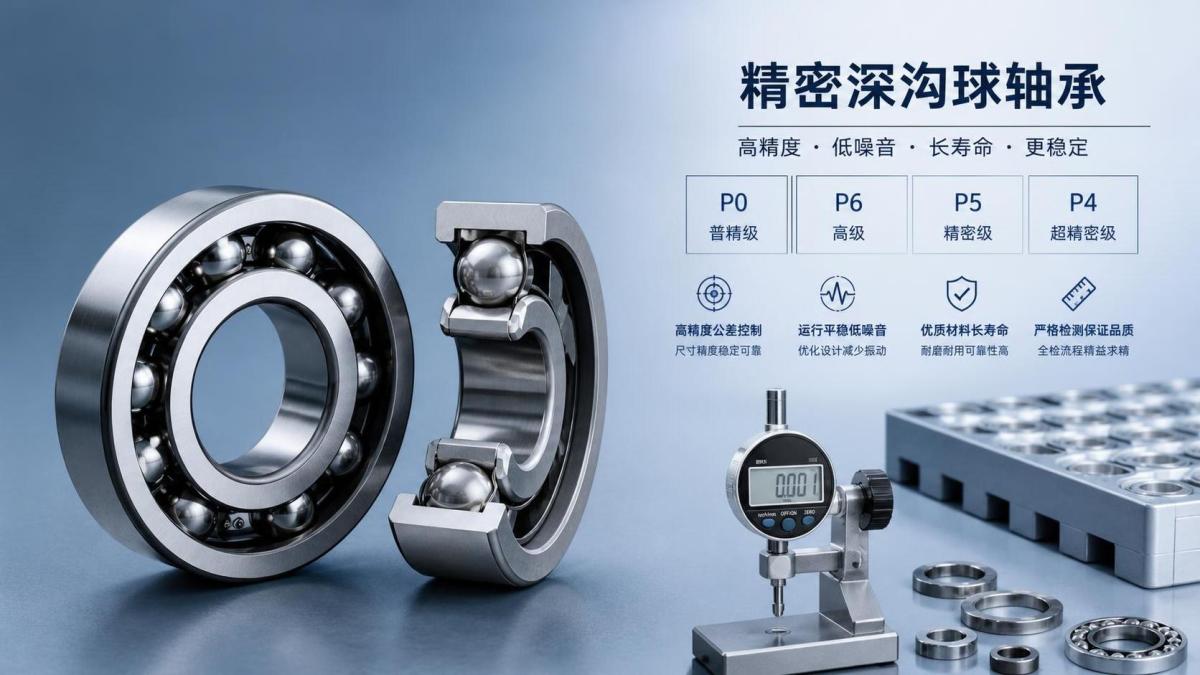
A practical way to choose between P0, P6, P5, and P4
There is no universal shortcut, but a simple screening logic helps.
P0 is usually the starting point for ordinary industrial duty. If the machine speed is moderate, load is stable, and there is no strict demand for rotational accuracy or low vibration, this grade is often adequate.
P6 is commonly considered when a machine needs better running accuracy or smoother behavior, but not at the level of true high-precision equipment. Many motor and reducer applications fall into this middle ground, though final suitability still depends on fit, lubrication, and assembly quality.
P5 and P4 are usually chosen when rotational accuracy is directly tied to machine output or when speed and vibration limits are much tighter. At that point, it is worth checking the entire system: shaft tolerances, housing geometry, preload or clearance design, and even transport handling. Buying a higher grade while ignoring those details is often an expensive compromise rather than a real upgrade.
Precision grade and clearance should be discussed together
In deep groove ball bearings, the grade tells you how accurately the bearing is made, but clearance helps determine how it behaves once mounted. This is especially relevant for electric motors, fans, and general industrial rotating equipment. A bearing with tight accuracy but the wrong clearance can generate excess preload after fitting, especially if the inner ring runs hotter than the outer ring.
That is why product options offering both multiple grades and multiple clearances are useful in practice. For example, NTN-6214CM-Deep Groove Ball Bearing is available in P0, P6, P5, and P4, with clearance options from C2 to C5. On paper, that looks like a specification list. In actual purchasing, it means the same bearing size can be adapted to very different operating conditions instead of forcing a one-size-fits-all decision.
Why dimensions and material still matter
Precision discussions can become too abstract if they are separated from the actual bearing. A 6214CM type, for instance, with a 70 mm bore, 125 mm outer diameter, and 24 mm width, fits a broad range of industrial equipment. If it is made from Chrome steel GCr15 and uses a steel cage, that points to a familiar industrial configuration rather than a niche specialty design. The question then becomes less about whether the bearing is “good” and more about whether the selected precision and clearance match the shaft fit, speed, lubrication method, and expected duty cycle.
This is also where import-export experience matters. Different buyers may request the same dimensional model but under different standard expectations, documentation habits, or OEM supply requirements. A supplier that understands both production and export workflows is usually better positioned to catch those mismatches before shipment.
Questions worth asking before placing the order
If the application is not fully defined, these points usually matter more than brand comparison alone:
- What is the actual operating speed, not just the motor nameplate speed?
- Is vibration, noise, or positional accuracy part of the acceptance requirement?
- What are the shaft and housing fits, and how stable is machining quality?
- Will operating temperature reduce internal clearance after mounting?
- Is the bearing for standard replacement, OEM production, or a redesigned assembly?
If these answers are unclear, the safest approach is usually not to jump to the highest precision grade, but to review the whole mounting and operating condition first. Many bearing problems blamed on grade are actually caused by contamination, improper fit, or lubrication errors.
Deep groove ball bearing precision grades are useful when they support a specific operating need. They are less useful when treated as a marketing shortcut. In selection work, the best result usually comes from balancing grade, clearance, load, speed, and installation quality together. That is the point where bearing choice stops being a catalog exercise and starts becoming reliable engineering.
Navigation
Send Us A Message
consult

Jinan Lanyu Import & Export Co., Ltd. is a bearing manufacturing enterprise specializing in the import and export trade of bearings. Covering a total area of 50,000 square meters, the company boasts an annual production capacity exceeding 20 million sets and is dedicated to the manufacture of high-quality bearings.

First class quality service and professional after-sales team.
Get in Touch
*We respect your confidentiality and all information are protected.
