


Deep Groove Ball Bearing Price Factors vary widely depending on material grade, precision level, load capacity, brand reputation, and order volume. For buyers in the bearing industry, understanding these cost drivers is essential to making informed sourcing decisions. As a bearing manufacturing and import-export enterprise, Jinan Lanyu helps global customers evaluate bearing quality, performance, and pricing to find reliable solutions for deep groove ball bearings and related products.
What Buyers Really Want to Know About Deep Groove Ball Bearing Pricing
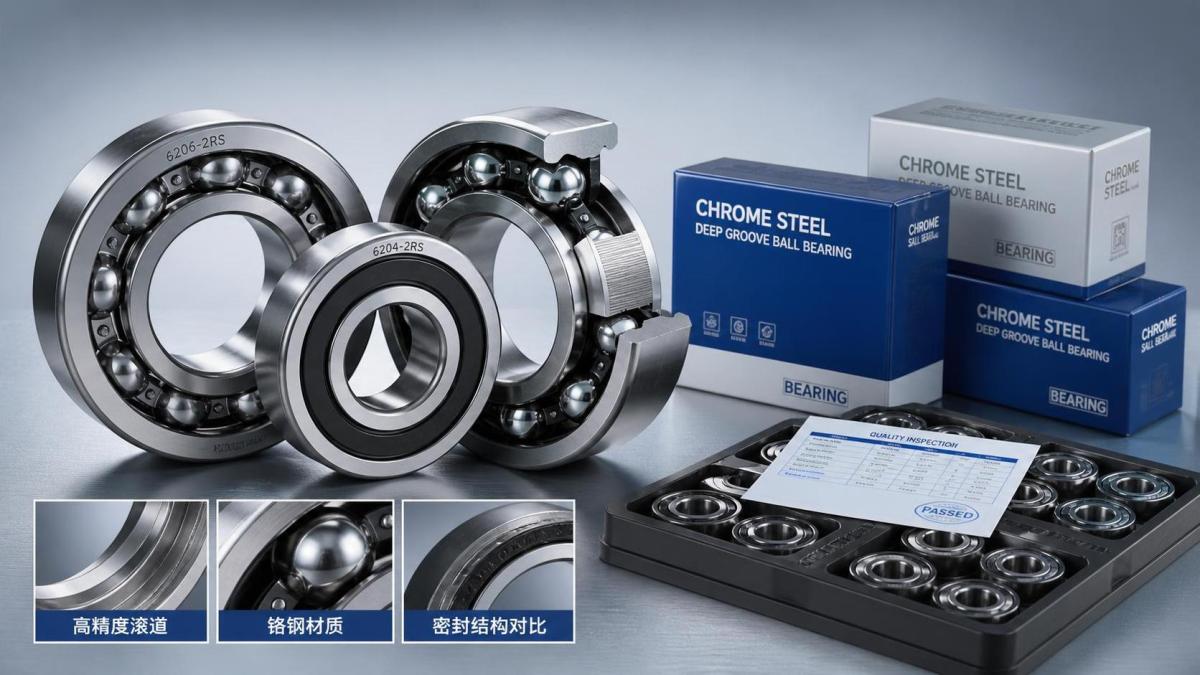
When buyers search for deep groove ball bearing price factors, they usually want a practical answer: why do similar-looking bearings have very different prices, and which differences actually matter in use?
The short answer is that bearing price is tied to performance risk. Lower prices may work for light-duty use, but demanding applications often require tighter tolerances, better steel, and stronger quality control.
For importers, distributors, and equipment manufacturers, the goal is not simply to find the lowest quotation. It is to choose a bearing that balances acquisition cost, service life, reliability, and supply stability.
The Main Factors That Influence Deep Groove Ball Bearing Price
Material quality is one of the biggest price drivers. Bearings made from high-grade chrome steel generally offer better hardness, wear resistance, and fatigue life than products using inconsistent raw materials.
Heat treatment also affects cost. Even when two bearings use similar steel, the one with better heat treatment control usually delivers more stable hardness and longer operating life, especially under continuous loads.
Precision grade is another major factor. Higher precision bearings require stricter machining, inspection, and finishing standards. That additional process control increases manufacturing cost, but it also improves rotational accuracy and running stability.
Internal clearance matters as well. Different clearance classes are designed for different operating temperatures, speeds, and shaft fits. Selecting the wrong clearance may cause noise, heat buildup, or premature failure.
Load capacity and size naturally influence pricing. Larger bearings or bearings designed for heavier radial and axial loads need more material, stronger raceway design, and tighter production consistency.
Surface finish, cage quality, lubrication condition, and sealing design can also change the final quote. These details may seem minor during purchasing, but they strongly affect maintenance intervals and field performance.
Brand reputation contributes to pricing because established manufacturers usually invest more in process control, testing, traceability, and global after-sales support. Buyers often pay more for lower failure risk and more predictable quality.
Order quantity has a direct impact on unit cost. Bulk purchasing often reduces price through production efficiency, packaging optimization, and freight savings, while small trial orders usually carry a higher per-piece cost.
Why the Lowest Price Can Become the Highest Cost
Many buyers compare only the unit price at the quotation stage. In practice, the more important figure is total operating cost over the bearing's service life.
A cheaper deep groove ball bearing may lead to machine downtime, extra maintenance labor, rejected production, or emergency replacement purchases. These hidden costs often exceed the savings from choosing the lowest-priced option.
This is especially true in applications involving motors, pumps, agricultural machinery, conveyors, or industrial fans. If a bearing fails early, the financial impact extends beyond the replacement part itself.
For that reason, experienced sourcing teams evaluate price together with expected lifespan, consistency between batches, technical support, and logistics reliability. A fair price is often more valuable than the lowest offer.
How to Judge Whether a Bearing Quote Is Reasonable
Start by checking whether the quotation clearly defines material, precision grade, clearance, lubrication condition, seal type, and inspection standard. A low price without these details is difficult to evaluate properly.
Next, compare the application requirements. A bearing for low-speed household equipment does not need the same specification level as one used in industrial machinery with continuous load and higher temperatures.
Ask suppliers about origin of raw materials, production process, testing methods, and batch consistency. Reliable suppliers should be able to explain how product quality is controlled, not just provide a number.
It is also useful to confirm packaging, lead time, export experience, and warranty terms. For international buyers, shipping reliability and documentation accuracy can affect total procurement cost as much as the bearing price itself.
Samples or small pilot orders are often a smart step before large-volume purchasing. They help verify noise level, running temperature, dimensional consistency, and compatibility with the target equipment.
What Procurement Teams Should Prioritize When Comparing Suppliers
Not all suppliers are competing on the same basis. Some focus on the lowest entry price, while others offer stronger manufacturing consistency, OEM support, and more flexible export service.
For business buyers, the best supplier is usually the one that can match specification to application, maintain stable quality, and support repeat orders without major variation between batches.
This is where an experienced import-export bearing company adds value. Instead of treating bearings as generic parts, a knowledgeable supplier helps customers avoid overspecification and underspecification at the same time.
Jinan Lanyu works with global customers in bearing trade by focusing on practical selection, consistent supply, and product solutions across deep groove ball bearings, self-aligning ball bearings, and cylindrical roller bearings.
Price Factors Often Overlooked by New Buyers
One commonly overlooked factor is tolerance to operating conditions. Bearings installed in dusty, humid, high-speed, or vibration-heavy environments need more than standard pricing comparison.
Another is the cost difference between standard stock and customized supply. OEM packaging, special lubrication, non-standard clearance, or higher precision matching can all increase price, but may be necessary for the end use.
Some buyers also ignore freight structure. A lower ex-works price may become less attractive after packaging charges, inland transport, export handling, and international shipping are added.
Currency fluctuation and raw material market changes can affect timing as well. For long-term procurement planning, stable supplier cooperation may deliver better value than repeated short-term quote shopping.
A Useful Reference Point When Comparing Bearing Types
Although this topic focuses on deep groove ball bearing price factors, comparing related bearing categories can help buyers understand how specifications shape cost across the broader market.
For example, NSK NU310EW Cylindrical Roller Bearing is offered with Chrome steel GCr15 material, multiple precision grades from P0 to P4, and clearance options from C2 to C5.
Its 50 mm bore diameter, 110 mm outer diameter, and 27 mm width show how dimensional requirements, material quality, and precision options directly influence pricing structure in industrial bearing procurement.
This kind of comparison helps buyers recognize that price is rarely based on size alone. Precision class, clearance flexibility, and application fit all contribute to the final commercial value.
How to Make a Better Buying Decision
The most effective way to control bearing cost is to define the application clearly before requesting quotations. That includes load, speed, operating temperature, lubrication method, installation conditions, and expected service life.
With that information, suppliers can recommend an appropriate specification rather than quoting an unsuitable low-end or unnecessarily high-end option. Better input usually leads to better pricing decisions.
Buyers should also compare offers on a same-specification basis. Price comparisons are meaningful only when material, tolerance, clearance, seal design, and inspection expectations are aligned across all suppliers.
When long-term supply is important, evaluate communication quality and technical response speed. A supplier that solves specification problems early can save significant time and cost later in the purchasing cycle.
Conclusion
Deep groove ball bearing price factors are shaped by more than simple product appearance. Material grade, precision, clearance, brand reliability, order volume, and application demands all influence real value.
For serious buyers, the key is to evaluate price together with performance, consistency, and supply support. That approach reduces failure risk, improves lifecycle cost, and leads to more dependable sourcing results.
In the bearing trade, informed purchasing is not about choosing the cheapest offer. It is about selecting the bearing solution that fits the job, protects uptime, and delivers stable value over time.
Navigation
Send Us A Message
consult

Jinan Lanyu Import & Export Co., Ltd. is a bearing manufacturing enterprise specializing in the import and export trade of bearings. Covering a total area of 50,000 square meters, the company boasts an annual production capacity exceeding 20 million sets and is dedicated to the manufacture of high-quality bearings.

First class quality service and professional after-sales team.
Get in Touch
*We respect your confidentiality and all information are protected.
